Dive Brief:
-
Ross Stores Inc. on Thursday reported that customer traffic spiked Q2 comparable sales by 10% compared to last year, its second straight quarter with double-digit comp growth. Store visits in the period rose more than 16%, according to data from Placer.ai.
-
The increase in transactions came from new customers, lapsed customers who returned and existing customers who shopped more frequently, executives told analysts Thursday.
-
The comp strength beat analyst expectations, quite unlike the performance at off-price leader TJX Cos., whose Marmaxx division – including U.S. chains T.J. Maxx and Marshalls – on Wednesday posted a surprisingly weak 1% comp increase.
Dive Insight:
Under CEO James Conroy, who arrived early last year, Ross has been elevating its merchandising — bringing in more brand names and revamping its stores — as well as its marketing, and it’s all paying off.
“Ross is now retail's boss,” Wells Fargo analysts led by Ike Boruchow said in a Thursday research note.
Total Q2 sales rose 13% to $6.3 billion. Excluding $253 million in tariff refunds, operating margin expanded by 205 basis points. The refunds contributed 405 out of the 610 basis-point increase in operating margin, which topped $1 billion in the quarter. Net earnings ballooned 68% to $851.3 million.
The company expects the comp strength to continue into the second half of the year, on pace to rise 6% to 7% in Q3 and 4% to 5% in Q4, Chief Financial Officer William Sheehan told analysts.
Eventually those lofty numbers will come down, but the retailer’s ongoing initiatives have the potential to stoke growth “through at least 2027 before the company likely settles into a more normalized low-single-digit comp cadence,” William Blair analysts led by Dylan Carden said in a Friday note.
Ross is also the boss, at least for now, of the off-price segment. For years these retailers have feasted on market share given up by department stores, and more recently there have been signs they might take from each other. This time around, Ross has probably taken market share from TJX, as evidenced by the disparity in their Q2 comp stats, because Ross has been quite conservative in its pricing, according to William Blair analysts.
That is working at a time when consumers are laser-focused on the price of all manner of things, including groceries, gas and discretionary goods.
“As we have pointed out, this is in stark contrast to TJX, which has seen outsized comp over the last one-and-a-half years led by price increases,” Carden said. “In the current environment, we think a better value proposition clearly is winning Ross incremental share, and it is nearly impossible to think some of that is not at the expense of TJX.”
When asked about this by analysts, Conroy acknowledged that the retailer has taken share in off-price, though he declined to agree that came from one specific competitor.
“Trying to not be immodest at all, just mathematically, over the last four quarters, we've grown stronger than each of the other two players,” he said, presumably referring to TJX and Burlington. “So mathematically, we've captured more share. So of the off-price retail market, we're a bigger piece than we were a year ago because we've outgrown them.”
In the end, Conroy is rooting for the off-price sector in general, calling the other major retailers in the space “both very formidable companies.”
“They're both extremely well run. We're all competing against each other, but we're also capturing share from a whole bunch of other places in the retail industry,” he said. “So to some degree, we want off price to win, and we just want to be a slightly bigger winner. So I couldn't comment on whether we're specifically impacting either of the other two players, one of which is much bigger than us and does a truly world-class job. So I'm not terribly worried about that.”
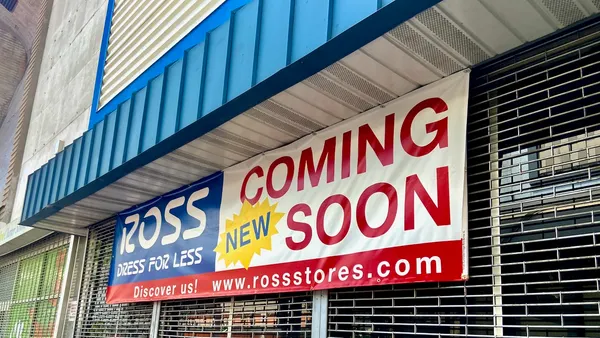
The Q2 performance has led Ross to boost its store expansion plans for 2026, from about 110 new locations to 115, the company said. In Q2, 35 Ross stores and 12 DD’s Discounts stores opened.