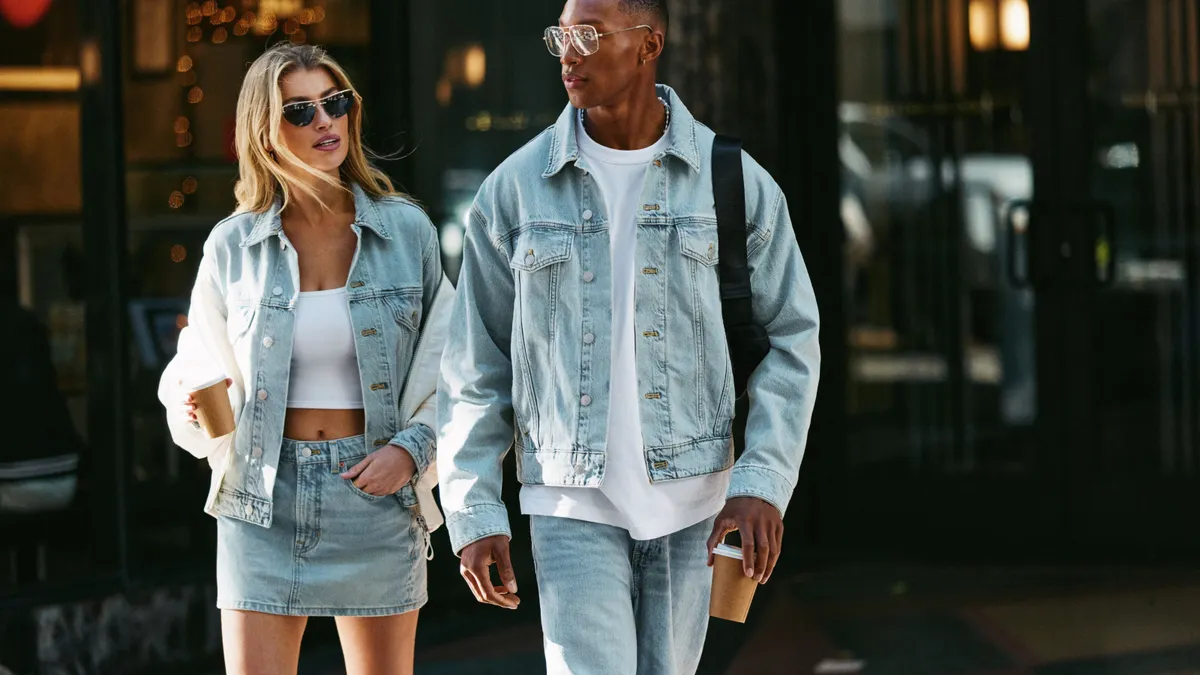
Apparel is changing. Vuori and Fabletics provided a microcosm of the shifts in the space with the simultaneous release of new denim collections earlier this year.
It’s a trend that’s been on the rise: athleisure brands are expanding further beyond their core offerings. At the same time, traditional apparel companies are staking a claim in activewear. Brands want to go where the money is, and sometimes that means broadening the scope of what they sell.
“All these brands, especially the public ones, need to show growth,” Suzy Davidkhanian, who heads up Emarketer’s retail practice, said. “At some point, there's only so much more explosive growth that they can show if they don't start to do something new.”
Innovation can happen within a category — new styles or colors of a core product, for example — but after that’s become saturated, “the next way to show growth is by introducing new categories,” she said.
This movement toward the middle, though, risks creating a world in which every apparel company sells everything.
Sometimes, that’s even the point.
Aerie started off as intimates but now sells a vast array of products, including a robust activewear assortment. “We dove into every category — and every category is really working for us,” Jennifer Foyle, president and executive creative director of American Eagle and Aerie, said at the ICR Conference in January.
That’s not necessarily a problem. But as the lines keep blurring between activewear and the rest of apparel, retailers must toe the line to prevent overextending their brand.
‘The trends have changed’
Lululemon’s recent stagnation has raised a slew of questions for activewear operators and apparel brands alike. Foremost among them: Is activewear slowing down?
In a post-Black Friday note last year, Needham analyst Tom Nikic highlighted the strength of “non-athletic brands” — including Levi’s, Ralph Lauren and Steven Madden — over the holiday shopping period.
“Essentially, we think that consumers spent 5 years purchasing clothes from a small group of brands and sub-categories (e.g. athleisure) and they're now looking for new brands and new categories to add to their wardrobes (e.g. denim, dress shoes, etc.),” Nikic wrote in emailed comments.
There are some signals to back this up. Kristen Classi-Zummo, an apparel analyst at Circana, said there’s been “a clear shift” away from leggings, sports bras and other performance products. But activewear still outpaces the overall apparel market, according to Circana’s Consumer Tracking Service.
“What we're really seeing is a meeting in the middle."

Kristen Classi-Zummo
Apparel analyst at Circana
As of January this year, activewear apparel sales in the U.S. were up 2% year over year, while nonactive apparel was down 2%. Jeans, a subset of nonactive apparel and a growth target for some activewear brands, grew 4% in the same period.
“What we're really seeing is a meeting in the middle. Consumers aren't gravitating toward overly performance-driven or tailored clothing,” Classi-Zummo said via email. “They're landing on casual, everyday categories like denim, sweaters, and sweats. It's less about choosing a side and more about comfort with versatility.”
Shifting trends may be part of the story, but to others the challenges at athletic retailers like Lululemon and Nike come down to product and innovation missteps. Not everyone in activewear is suffering; Adidas reported record revenues in its latest fiscal year.
Fabletics CEO Adam Goldenberg doesn't see a possible slowdown in consumer spending on athleisure happening. “I think that's the excuse of some of the big public players that have missed the mark on where the fashion's gone," he told Retail Dive in January.
Growth at Fabletics is actually accelerating, Goldenberg said. The activewear category is expanding, but now Fabletics, Alo Yoga and Vuori are taking “a lot of market share from incumbents.”
“In activewear, the trends have changed,” Goldenberg said. “So if you didn't have the right straight-leg and wide-leg in your fashion — if you weren't broadening your silhouettes in men's to also have some more baggy fit — there's just certain trends that I feel like, if you miss those, I think people are switching to other brands.”
Indeed, there are other indications that activewear is positioned to thrive for years to come. The number of inactive people in the U.S. has hit a historic low, according to the Sports & Fitness Industry Association. Wellness is still a priority for many shoppers and at the start of this year 96% of consumers planned to incorporate wellness into their life in various ways, Circana found.
“Young women are really dressing in personas today."
Matt Powell
Senior adviser with BCE Consulting
That aligns with how footwear and apparel brand On sees its consumer. The company, which posted 30% net sales growth last year, is pursuing a consumer co-founder David Allemann describes as part of the “movement class.” In short, they prioritize health and see longevity as a luxury, a guideline that helps define On’s premium positioning.
“We think there’s a big untapped market today to be more fashion-forward, while still offering the consumer a product that makes you enjoy your movement sessions, enjoy your run,” On CEO Martin Hoffmann told Retail Dive earlier this year. “We try to rather expand the market into the more premium space versus going straight into the heat of the competition, which undoubtedly is there.”
Focusing on the premium side of the market allows On “to chart our own way, not fishing in the same pond like everyone else.”
A new age of apparel
The apparel sector overall is going through a “malaise” right now as shoppers make do with what they have, Matt Powell, a senior adviser with BCE Consulting, told Retail Dive. If they are purchasing, it may be to fill a specific gap in their wardrobe, which could help explain why both activewear and other apparel brands are encroaching on each others’ spaces.
“Young women are really dressing in personas today. Today I'm active, tomorrow I'm bookish, I'm preppy,” Powell said. “She's got all these personas in her closet that she pulls out and she’s not dressing preppy every day or active every day.”
In practice, that means every brand has the potential to be a lifestyle brand. In order to grow, retailers need to build their assortment to capture the categories that are driving spending, Davidkhanian said.
Activewear has matured and performance fabrics transcended the category barrier years ago, leading to comfier dress shirts and stretchier jeans. All of that sets the stage for apparel brands with a more holistic set of offerings than in the past.
“The days of the merchant prince ... I think those days are long gone.”
Matt Powell
Senior adviser with BCE Consulting
“When times are good, it's easier to get people to buy one more black dress,” Davidkhanian said. Now, though, “it's much more about silhouettes and about being relevant.”
That’s an idea echoed by Classi-Zummo. Category diversification is directly tied to shopper wardrobes being more blended than in the past, she said. Brands that expand should be opting for “trend relevancy, not category confusion.”
“What's the current uniform everybody's talking about and wearing?” Davidkhanian said. “Make sure that they do that in a credible way, whatever that looks like to them. That's really important because at the end of the day, even when times are great … how many pairs of jeans or leggings or any one thing could they possibly need?”
Retailers that are good at this lifestyle positioning are tailoring their marketing accordingly, Davidkhanian said. For example, shoppers who are searching for airplane tickets should get served ads highlighting the travel components of a brand’s apparel, while those buying a gym membership get more workout-inspired advertising.
Still, this doesn’t mean retailers have carte blanche to enter any category they want. The customer ultimately decides what they’re comfortable with.
“Has your customer told you they want you to do this? Or are you simply looking at a whiteboard and saying, ‘Well, there's an empty space there. Let's go fill it,’” Powell said.
An activewear boom more than a decade ago saw brands like Calvin Klein entering the space just to get a slice of the market, Powell said, without the kind of thoughtful consideration needed. That won’t fly with today’s consumer.
“The days of the merchant prince — Mickey Drexler telling everybody, ‘everybody in khakis’ and they did, right? — I think those days are long gone,” Powell said.
Expansion is OK, with permission
While simple, asking the customer for permission may be the key to where apparel is going more broadly. Even for companies that have expanded significantly, like Aerie, it’s at the core of the strategy.
Aerie and American Eagle know who they are as brands and customers recognize the heart of both businesses: intimates and jeans, respectively. Staying true to that core has allowed them to expand without isolating their shopper, Foyle explained in January.
At True Religion, things went a little differently. Michael Buckley, who led the brand as president from 2006 to 2010, came to know the business as a purveyor of $300 jeans to the top 3% of the population. He was used to selling to the Nordstrom and Bloomingdale’s shoppers.
When he returned as CEO in 2019, a customer survey revealed that wasn’t True Religion’s shopper after all. The people who wanted to buy True Religion’s jeans were making $65,000 annually and not shopping at the high-end centers where True Religion opened stores.
“Little by little, the consumer said ‘it's okay for you to play in that classification.’”
Michael Buckley
True Religion CEO
Buckley’s discovery led to him changing the brand’s entire positioning. Instead of selling $300 jeans, True Religion started selling $50 jeans. Instead of operating in luxury shopping centers, True Religion moved closer to where its consumers lived and shopped, an evolution it was making as it closed dozens of stores and filed for bankruptcy.
He expanded the brands from jeans into T-shirts, hoodies and other categories, featuring some of the core design elements that made True Religion stand out: its horseshoe logo and signature stitching.
“Little by little, the consumer said ‘it's okay for you to play in that classification,’” Buckley told Retail Dive in January. “And we've just expanded to where we are today.”
Now, 60% of the retailer's business comes from categories outside of denim, Buckley said via email. True Religion will always be a jeans brand, but that doesn’t mean it doesn’t ride the same apparel cycles as everyone else. During the pandemic, the company sold a lot of joggers. When interest in denim came back, it sold more denim.
“The key for us is that we are in all the different categories,” Buckley said. “So if something becomes a huge trend — oversized T-shirts, or everyone's going back to joggers, whatever it is — our job as merchants is to be the first one that does that. When we see stuff on the runways in Europe, I want to be the first one: We call it being first to be second.”
Skechers is another brand Buckley says thrives at following wherever trends lead, and Classi-Zummo highlighted Hugo Boss as a successful diversifier that now has a “fresh, trend-relevant assortment” without abandoning its core.
“You cannot tell the customer, ‘Hey, I have this great thing. You need to buy this now.’”
Martin Hoffmann
On CEO
For some of today’s top activewear brands, Fabletics’ Goldenberg said customers have given them the permission to expand into more casual categories.
“Consumers are expecting that from our brands,” Goldenberg said of both Fabletics and Vuori.
Meanwhile, luxury player Vince has tried out both directions. Vince CEO Brendan Hoffman told Retail Dive in January that the brand has done loungewear capsules and would consider developing activewear with a partner, perhaps through brand management firm Authentic Brands Group, which owns Vince’s IP.
At the same time, the company is testing higher price-point items with more luxury fabrics and has seen success there as shoppers become more interested in dressing up again.
“It's not going back to suits and ties for men, which is probably good for him,” Hoffman said. At the same time, though, the shoppers of today are styling their sports coats differently than they used to, incorporating more casual styles like knits.
“There are ways to play with it, to elevate it. But for Vince, it's still very comfy and sophisticated,” he said.
If every apparel brand is empowered to try everything, then how do companies succeed today? The answer is an endless cycle of product innovation and consumer listening. Winning once doesn’t guarantee winning again — and above all, the customer decides.
“Your second customer matters as much as your 20 millionth customer,” On’s Hoffmann said about the brand’s approach to product creation and customer retention. “You cannot tell the customer, ‘Hey, I have this great thing. You need to buy this now.’”