
AI assistants are no longer a novelty. Among people who’ve tried AI-powered search, 44% now call it their primary and preferred way to search the internet, compared with 31% who prefer traditional search, McKinsey reports. For retailers, showing up in AI shopping recommendations used to feel like the finish line. It’s turning out to be closer to the starting line.
Plenty of retailers are treating agentic readiness like a technology purchase: buy the integration, flip the switch, done. That assumption is where many agentic commerce plans start to unravel.
An agentic-ready store can be found. An agentic-optimized store holds up when an AI agent checks its product data, pricing and inventory in real time. Getting there takes a handful of concrete steps your team can act on now.
Where readiness stalls before it starts
Gartner predicts more than 40% of agentic AI projects will be canceled by the end of 2027 due to escalating costs, unclear business value or inadequate risk controls. All three trace back to planning.
Measurement is a common blind spot. Only 32% of commerce organizations report fully defined AI success metrics, and just 27% report unified customer data across sales, service, marketing and commerce, according to Salesforce. Without either, it’s hard to tell whether an agentic investment is working.
Retailers also tend to overestimate the effort required. “A common misconception is that agentic commerce requires a large AI transformation before retailers can make meaningful progress,” says Abhay Singhal, co-founder of InMobi, the global technology company behind Glance, and CEO of InMobi Advertising. “In practice, much of the work starts with the commerce infrastructure they already have.”
The gains are within reach. Retailers that have launched AI-enabled experiences report conversion gains of 5% to 15%, according to BCG. “That work has immediate value,” Singhal says. “Cleaner product data and more reliable commerce systems improve how products appear across AI assistants, search, marketplaces and retailers’ own digital channels.”
Three challenges hindering your store’s agentic optimization
Chances are your store already shows up when an AI agent goes looking, thanks to automatic backend updates you didn’t have to build yourself. That gets your products noticed. It doesn’t guarantee they get picked.
A human shopper might be won over by a brand story, an aesthetic or emotional pull. An AI agent weighs structured data: price, availability and hard specifications. “Treat the agent as a new kind of customer,” Singhal says. “It doesn’t respond to branding the way a person does. It evaluates everything it can access, and inconsistencies weaken its confidence. A single wrong price can make it less likely to recommend you.”
In a Mirakl survey of seven technology and consulting partners, including Deloitte and Accenture, respondents scored retailer readiness for AI agents no higher than 4.8 out of 10 in three areas: catalog discoverability, visibility in AI-driven search and operational reliability. InMobi’s own scans tell a similar story. Of more than 8,000 retail sites run through Glance’s ReadySetAgent tool as of mid-September, the top score was 61 out of 100.
Catalog data
Adobe’s scoring of U.S. retail sites found product pages average 66% machine readability, the lowest of any page type Adobe reported on. “An AI agent can only make a useful recommendation with the information it can access and understand,” Singhal notes. “The more clearly a retailer communicates attributes such as fit, compatibility, availability and price, the better equipped the agent is to match a product to what a shopper actually needs.”
“If those details are missing or buried in unstructured copy, an agent has less to work with,” he adds. That clarity converts. In the second quarter of 2026, Shopify found that AI-referred shoppers who reached a product page converted approximately 80% better than organic-search referrals, with that advantage rising to roughly twice the conversion rate in specification-intensive categories.
Visibility and monitoring
Agent access can break without anyone noticing. Monitoring has to be ongoing, Singhal cautions, “because a website update, authentication change or platform migration can affect agent access without creating an obvious problem for a human shopper.”
Operational reliability
Even when the technical connection is live, the accuracy behind it often isn’t. Among multichannel commerce organizations, 41% report inconsistent pricing and promotions across channels, and 40% report inventory that isn’t synced in real time, according to Salesforce. “In the holidays, price and stock change hourly,” Singhal notes. “A wrong answer is worse than no answer, and the shopper blames the retailer.”
The payoff for doing the work
For the upcoming holiday season, Salesforce predicts 20% of e-commerce traffic will originate from AI chat agents.
Sucharita Kodali, vice president and principal analyst at Forrester, also expects more shoppers to try AI tools for holiday shopping. Whether that added traffic pays off depends on the answers shoppers get. “Do people feel like they found the best product or the best deal? If they get satisfactory answers, then yes, they may come back,” Kodali says.
Helping shoppers act on what agents recommend
Making product data readable and reliable improves a retailer’s chances of appearing in AI-generated recommendations. But earning a place on an agent’s shortlist is only part of the opportunity. The next challenge is helping consumers evaluate those recommendations and feel confident enough to act on them.
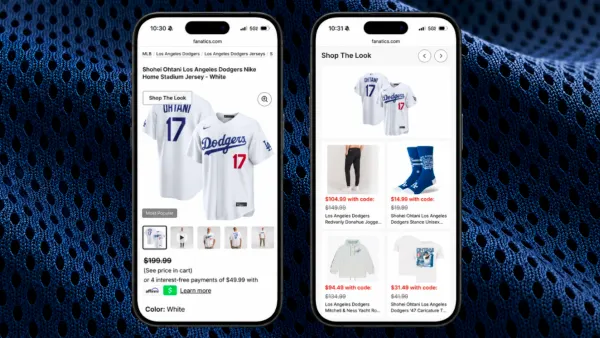
“Visual capabilities can make a recommendation more useful in categories such as fashion, beauty and home,” Singhal says. “Showing how a product may look on a person or within a particular setting gives the shopper information that text alone cannot provide.”
Glance’s AI personal shopper recommends products on smartphones, apps and TVs across more than 60 million U.S. devices, often before a search begins. With its Visual Dialogue feature, shoppers upload a selfie, see products on themselves in real-life settings and explore options conversationally. When they’re ready to buy, they step into the retailer’s own website.
For brands, that links discovery, consideration and conversion in a single journey, with the sale completed on their own storefront. In early U.S. trials, 40% of users tapped through to begin a shopping journey, Glance reported. “Brands that already run a product feed for Google or Meta can connect it to our agent as is,” Singhal says.
Optimizing top products for holiday shoppers
With Black Friday just weeks out, Singhal suggests beginning with a manageable set of priority items, such as a retailer’s top 200 holiday products, though the right number will vary by catalog and sales mix. From there, he says, “Sync price and stock as often as they change, publish shipping cutoffs and return policies where agents can read them and tag AI traffic before peak.”
From agentic-ready to optimized, one step at a time
Shopper behavior and agentic commerce standards are evolving fast. That makes a custom integration for every new AI channel a risky bet, since those connections change every quarter. “Own what differentiates your brand, like your product data and customer experience, and lean on shared standards and partners for the connections,” Singhal advises.
The work done now carries well past the holidays. “Retailers have spent years optimizing their stores for the way people search and browse,” Singhal concludes. “Now they also have to consider how AI agents evaluate products and how consumers make decisions with those agents’ help. The opportunity is to connect reliable product information with experiences that give people greater confidence in what they’re buying.”
See how agent-led discovery can supercharge your store traffic.
Learn how Glance can turn product data into confident shopping decisions on smartphones and TVs.