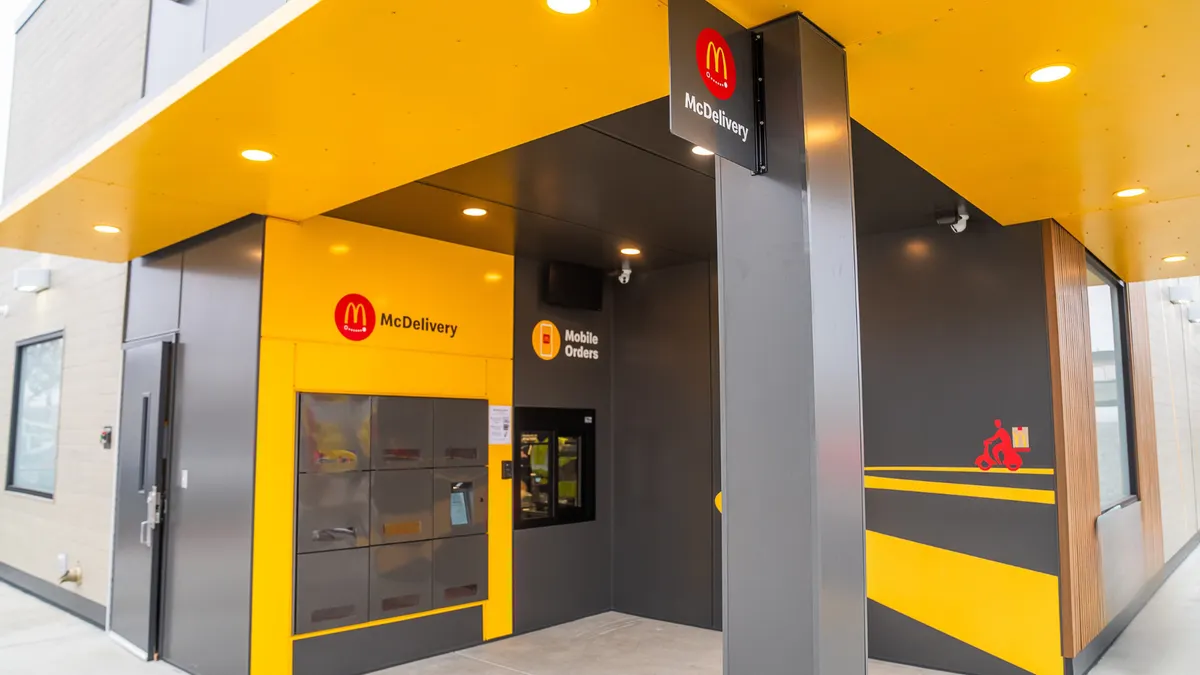

The ever-expanding big-box store is giving way to something smaller. Across the retail and restaurant sectors, brands are trimming their physical footprints, trading flagship-sized locations for compact formats built around how customers shop and eat today. E-commerce, delivery and buy-online-pickup-in-store have reduced the floor space a brand needs to serve the same customers, and rising real estate costs have made the decision easier. Department-store and grocery names from Macy's to Whole Foods are formalizing small-format concepts they once treated as experiments, while restaurant operators from Portillo's to Jack in the Box are rolling out prototypes that cut square footage without cutting volume.
A smaller box doesn't come with smaller revenue expectations. If anything, the pressure to extract more value from every square foot has intensified. That's pushing retailers and restaurant operators to rethink what a shrinking footprint can do, and it's turning store design and construction into a real competitive advantage.
Doing more with the space you have
The first response to a smaller footprint is design efficiency: flexible fixtures, multi-use zones and layouts that serve multiple functions throughout the day rather than a single static purpose. That's necessary, but for a growing number of brands, it isn't enough on its own. The more ambitious move is to turn part of their footprint into a second revenue stream through a store-in-store, or "shop-within-a-shop," concept.
The idea is simple to describe and much harder to execute — a second, distinct brand operating inside an existing store, sharing the same four walls but running as its own retail environment. Done well, it lets the host retailer monetize space more efficiently, increase foot traffic and dwell time and give customers something they can't get elsewhere, without adding a single square foot of real estate.
The construction complexity behind a simple idea
From the customer's perspective, it looks like a straightforward build-out. From a construction and program management side, it's a different animal. Store-in-store programs require reconciling two brands' design standards in a single space. They require adapting mechanical, electrical and plumbing systems that weren't designed for a second tenant. They also require navigating permitting that shifts depending on how the second brand space is classified. Most of this happens while the host store stays open, because there's rarely an option to close for a full renovation. The discipline is what makes the model repeatable and scalable. Companies that get the sequencing and the upfront documentation right can run it across dozens of sites. Get it wrong, and every location can become a custom project.
Programs at that scale succeed or become delayed based on how well the construction team standardizes a repeatable process across sites that are each, in some way, unique: different existing conditions, different local permitting requirements, different operational constraints from the host store. A phased schedule, paired with accurate documentation of each existing space before work begins, makes it possible to execute at volume.
Sevan Multi-Site Solutions managed exactly this kind of program for Walgreens and Kroger, remodeling 50 co-branded locations to bring Kroger Express grocery into Walgreens stores. The work meant blending two sets of retail standards, equipment packages and visual identities within existing footprints, plus integrating new freezer and refrigeration lines, all sequenced around active store hours, so both brands kept serving customers. Sevan completed all 50 remodels within 18 months, while the stores remained open throughout the process. Walgreens reported a front-end sales lift of more than 19% from the new model, which the company cited as its largest front-end conversion.
What this means for the next wave of store and restaurant design
As footprints shrink across the retail and restaurant sectors, expect shared-space concepts to become more common. Store-in-store is moving from a niche tactic to a reliable way to raise revenue per square foot without taking on more real estate. But the brands that win with it will be those that treat it as a construction and program management discipline, as well as partner with teams who can execute complex, multi-brand builds without disrupting the store that's already open.