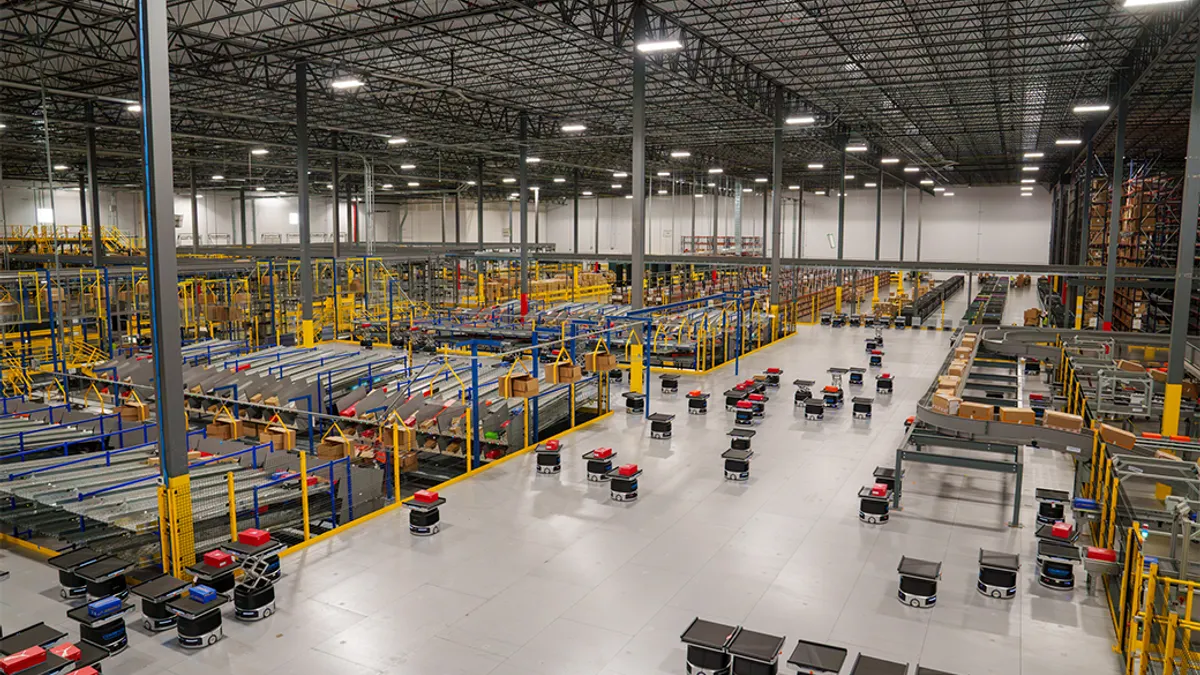

Large, highly automated distribution and fulfillment centers are making headlines as retailers invest in new ways to expand capacity and move products more efficiently. For retailers and brands evaluating their own operations, the goal should not be to automate as much as possible. It should be to determine what level of automation can solve the right operational problems at a sustainable cost.
That answer varies by operation. Order profiles, SKU characteristics, service requirements, labor availability and demand fluctuations all influence which technologies will be effective. Retailers must also decide whether to invest in and manage automation internally or access those capabilities through a third-party logistics provider.
The right approach begins with the operation, not the technology.
How do you determine the right level of warehouse automation?
The optimal level of warehouse automation is the simplest combination of processes, systems and technology that can reliably meet service requirements at a sustainable cost while adapting to changes in volume and order mix.
Start by identifying the broader operational challenge the business needs to address. Common constraints include rising labor costs, limited workforce availability, order accuracy, insufficient throughput, space limitations, inventory visibility and the ability to scale during peak periods or periods of rapid growth.
Next, evaluate how those challenges affect the operation as a whole. An automation solution that increases picking capacity, for example, may create limited value if packing or shipping cannot support the additional volume. Likewise, technology designed to reduce labor requirements may not deliver the expected return if demand is too variable to keep it consistently utilized.
Before selecting a solution, evaluate the complete fulfillment flow. Key factors include:
- Baseline and peak order volumes
- SKU count, dimensions and velocity
- Order lines and units per order
- DTC, wholesale and omnichannel requirements
- Available space and labor
- Service-level commitments
- Growth and channel-expansion plans
- WMS, OMS and integration readiness
Two retailers shipping similar volumes may need very different levels of automation because their products, demand patterns, operating costs and customer requirements differ.
When does in-house warehouse automation make sense?
Implementing and managing warehouse automation within a retailer’s own operation can make sense when the company has a long-term facility strategy, a relatively predictable workload and the internal resources to support the technology.
Managing automation in-house does not necessarily mean purchasing the equipment outright. Depending on the technology and provider, retailers may purchase or lease the equipment or access it through a Robotics-as-a-Service (RaaS) arrangement. These options can change the upfront capital requirements and payment structure, but the retailer still needs the systems, processes and internal resources to integrate the technology into its operation and manage its performance.
Consistent utilization is important, particularly for systems designed around specific product dimensions, storage configurations or throughput requirements. Retailers should consider how changes in assortment, packaging, sales channels or order profiles could affect the solution over time.
The investment also extends beyond equipment. Implementation may require systems integration, engineering support, process redesign, associate training, spare parts, maintenance and downtime planning. Reliable inventory and product data are essential, as is the ability to connect the automation with the order management, warehouse management and execution systems directing the work.
An in-house model may provide greater control and customization. It also places responsibility for maintaining and optimizing the technology on the retailer throughout its lifecycle.
When does outsourcing automated fulfillment make sense?
Outsourcing deserves consideration when a retailer needs scalable fulfillment capacity along with the infrastructure, systems and expertise required to operate it.
This may be particularly relevant when demand is variable, growth is outpacing the existing operation, fulfillment requirements are changing or capital is needed elsewhere in the business. Instead of managing automation as a standalone asset, the retailer accesses it as part of a broader operating model.
An experienced 3PL may evaluate and pilot technologies, integrate them with warehouse systems, train associates and refine workflows as requirements evolve. Depending on the solution, the technology may already be operating within the 3PL’s network or may be designed with automation providers and systems integrators for a specific application.
The facility model matters as well. In a multi-client operation, compatible automation may serve several customers, allowing infrastructure and technology resources to be shared. A dedicated operation may be more appropriate for specialized requirements or consistent volumes that support a customized design.
How should retailers compare the business cases?
Compare the total cost-to-serve under equivalent volumes and service requirements, not simply the purchase price of equipment with a 3PL’s rates.
For an internal investment, include equipment, integration, training, maintenance, technical support and expected downtime. For an outsourced model, consider implementation costs, service charges, minimum commitments and the cost of changing capacity or workflows.
Test both models against several scenarios, including lower-than-expected demand, higher seasonal peaks and changes in order mix. Track cost per order alongside throughput, accuracy and on-time shipment. This shows whether projected savings depend on operating conditions that may not persist.
What should retailers verify before choosing a 3PL?
Assess the provider’s experience with similar automation applications and implementations. Ask how the technology will be tested and integrated, who will maintain it and how operational exceptions will be resolved.
Responsibilities should be clear for systems integration, maintenance, performance monitoring and future modifications. Retailers should also understand what would need to change if volumes increase, new products are introduced or another sales channel is added.
Warehouse automation is not a one-time decision. The strongest strategy is one that can evolve as the operation changes. Whether technology is owned internally or accessed through a 3PL, success depends on solving clearly defined problems, measuring operational outcomes and preserving enough flexibility for what comes next.