
AI agents have become part of how retailers talk to their customers. U.S. customers, however, are less sure about that arrangement.
Two recent Sinch studies show a gap I’ve already seen in the market. The AI Production Paradox research found that 63% of retail brands have already gone live with AI customer communications agents. But only 43% of shoppers globally think AI will make their holiday shopping easier, according to Sinch’s 2026 Black Friday and Cyber Monday consumer survey, which included 2,501 shoppers across eight countries. That’s five points lower than a year earlier. In the U.S., the most AI-skeptical market, that number drops to 26%.
The data might look worrying, but the survey also shows where shoppers are ready for AI and which jobs they trust it with most. The area retailers should focus on most? The part of the holiday season that runs longest.
Shoppers judge AI customer communications by the job
The five-point decline in AI optimism measures how shoppers feel about AI in the abstract. But when asked about specific jobs, the answer is different. Only one of the 2,501 holiday shoppers surveyed said they didn't want to interact with AI under any circumstances. And for every task in the study – from product questions to billing changes – over half of U.S. holiday shoppers were confident AI could handle it.
Still, confidence varies significantly by job. In the U.S., 76% are confident AI can handle order tracking and 64% trust it to help them learn about a product. But ask shoppers about more sensitive use cases, and that confidence falls. Only 58% of consumers think AI can handle account changes well, and just 55% trust it for payment and billing requests.
The ranking in Sinch’s Black Friday and Cyber Monday research follows what's at stake, and understanding it is critical for retailers implementing AI across their customer communications program. Tracking a parcel only reports where it is, but account changes and billing move a shopper's money and data. Any mistake there comes at a higher cost.
The positive news is that this data offers a workable rule for retailers deploying AI agents: Shoppers accept AI that reports on an order but are still hesitant about AI that changes something on their behalf.
Post-purchase is where the season is decided
Applied to the holiday season, the rule points to post-purchase, the longest stretch of contact U.S. retailers have with their customers at this time of year. Black Friday orders turn into December gift deliveries with fixed deadlines, and some of those turn into returns well into January.
It’s also the most critical touchpoint for retailers: 93% of consumers consider shipping updates important to their shopping experience. 64% consider them very important. Get them wrong, and a hard-won customer may not come back.
That makes post-purchase the natural place to start. Shoppers want to be able to answer back during this stretch. An equal share, 93%, say it’s important to be able to respond to post-purchase messages such as order confirmations and shipping updates. The good news is brands have already spotted the opportunity: Sinch’s AI Production Paradox research found 49% of retailers are moving agents into customer service use cases, handling everything from order queries to returns.
In practice, though, those jobs don’t arrive one at a time. A shopper might ask where her parcel is – a task most U.S. shoppers trust AI with – and get a quick answer. But then her next message might say she’s been charged twice, which falls into the category shoppers trust AI with least. The agent’s job at that point is to recognize the switch and get her to a person, with the conversation intact, before a satisfied customer becomes a frustrated one.
Every failure lands on the brand
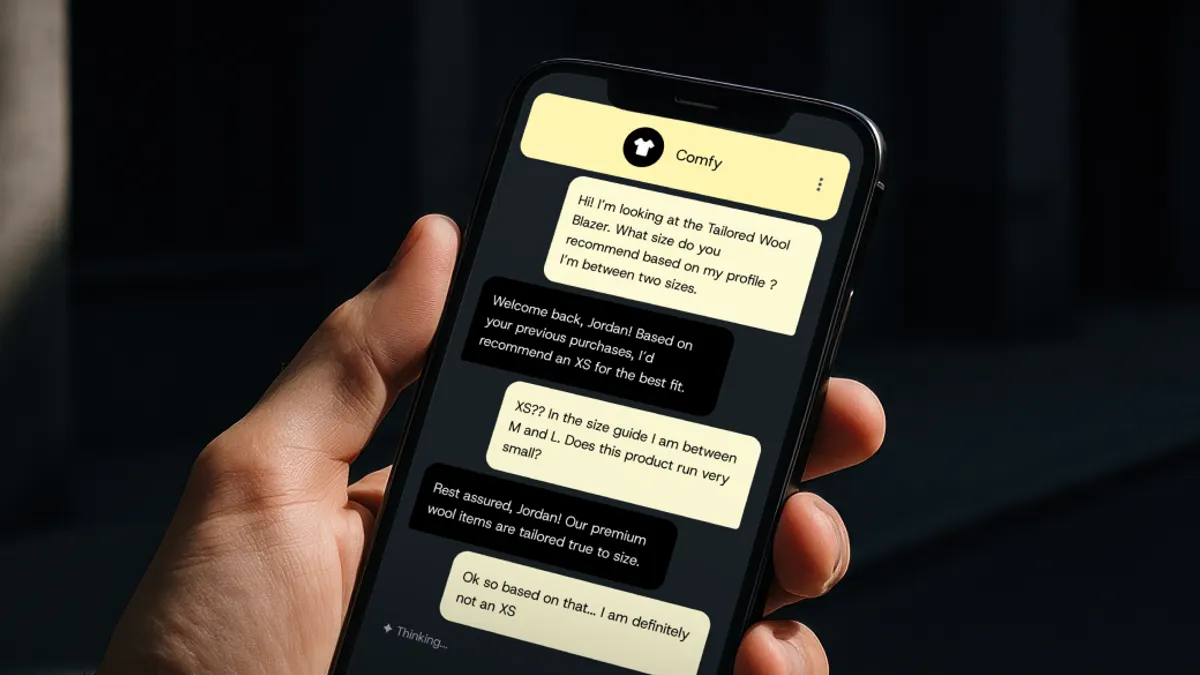
When an agent misses that moment or provides the wrong response, all the shopper sees is what it got wrong: a chatbot insisting a delayed delivery is on its way, or a voice assistant asking again for an order number they gave two minutes earlier. It’s something I hear often from the retailers I work with: Whichever system produced the mistake, the shopper holds the brand responsible.
No survey can measure what moments like that cost a single brand, but this year’s data shows which way shopper trust is moving. Beyond the five-point drop in AI optimism, the share of shoppers who said they’d trust a person’s advice over AI rose slightly, from 51% to 53%. And only 7% of consumers said they have no concerns about AI at all, down from 9%.
All of this points to an increase in AI skepticism among U.S. shoppers, who worry most about what happens to their data, miscommunication or unhelpful answers and irrelevant or pushy messages. Privacy and data use tops the list of concerns globally, at 43%, all while retailers are dealing with the same risk from the inside. According to Sinch’s retail research, customer data exposure is the leading cause of AI agent rollbacks in retail, at 28%, followed by hallucinations or off-brand responses at 18%.
Putting AI to work after checkout
Shoppers aren’t opposed to AI agents that add value to their shopping, but retailers need to be deliberate about how they deploy them. Combined, these two studies point to six practical changes: some to make before the December delivery rush, and some to take into the new year.
Before the delivery rush:
1. Start where shoppers already trust AI. Order tracking and product questions are the jobs shoppers are most ready to hand over to agents. Launch there and expand once consumer sentiment toward the agents is strong.
2. Hand money questions to people early. Payment and billing has the lowest confidence of any task in the study. A double charge in December is a poor moment to find out whether an agent can resolve it. Set the right handoff triggers now for any conversation that involves money and personal data.
3. Be open about your use of AI. Telling shoppers when they’re talking to an AI agent costs little. In the U.S., AI skepticism is the highest of any market, so transparently sharing who they’re interacting with, and what the agent can and cannot do, will be key to overcoming it.
Into the new year:
4. Make every update something a customer can reply to. A shipping notification that can't take a reply sends the customer to the support line with the same question, at the busiest point in the year.
5. Design the handoff before the agent. Fifty-two percent of shoppers are open to using a voice AI agent this season, provided they can transfer to a human effectively. But a transfer only works if the conversation travels with it: the order, what the agent already tried and what the shopper has said.
6. Build data guardrails into the foundation. Guardrails such as data masking keep an agent from exposing customer information. Many engineering teams rebuild them for every new agent, so each launch adds to the backlog and widens the risk. When guardrails live in the communications infrastructure layer, they cover every agent a retailer launches, including the ones it hasn’t built yet.
The list shoppers already wrote
Shoppers have handed retailers a deployment plan, ranked by confidence. The retailers who leave this holiday season with more of their customers' trust will be the ones who started at the top of that list and built the handoff with as much care as the agent.
Only 26% of U.S. shoppers think AI will make their holiday shopping easier this year. Retailers will get to decide this season, one post-purchase conversation at a time, what that number looks like next year.
Explore the findings: Sinch’s AI Production Paradox report digs into where retailers are deploying AI agents in customer communications. The 2026 Black Friday and Cyber Monday consumer survey shows where shoppers are ready to trust them.