

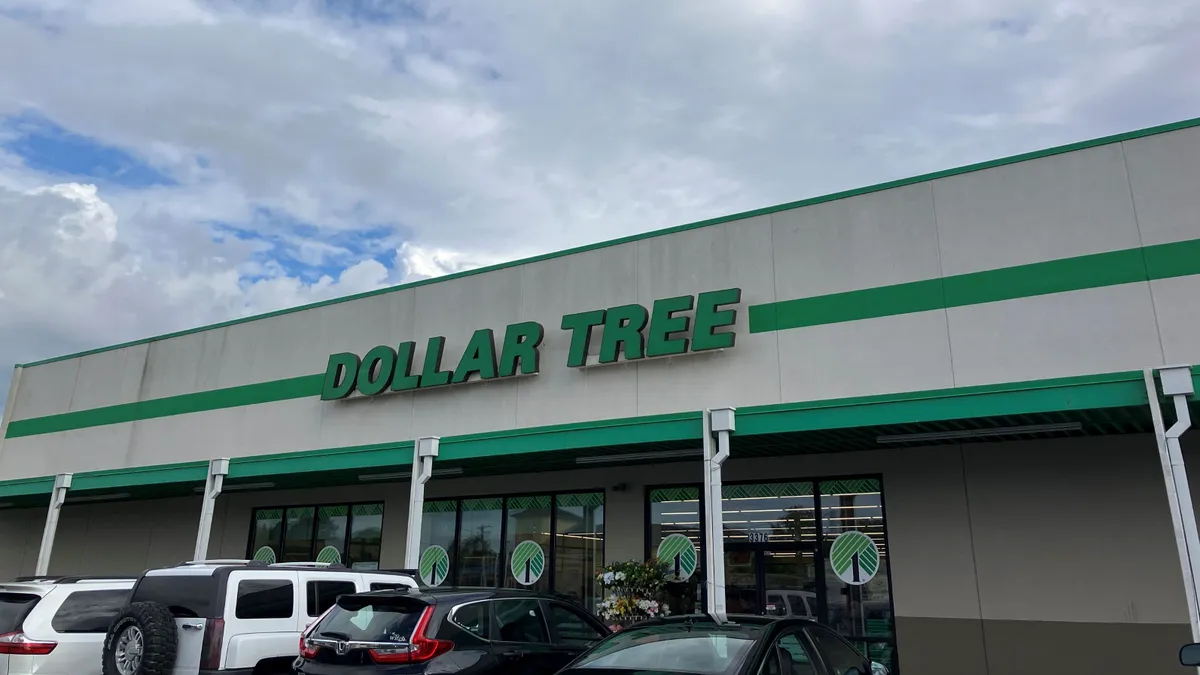
Dollar store executives have been touting gains with higher income shoppers over the past few quarters. That’s a customer acquisition win several years in the making and tracks with broader habits among higher income consumers.
“The interesting thing is that in the data, we have always seen that ... upper middle income people tend to be those who are more likely to take advantage of coupons, sales, just as a more general point,” Jessie Handbury, associate professor at The Wharton School and a Research Associate at the National Bureau of Economic Research, told Retail Dive. “Higher-income people taking advantage of lower prices is not a new thing.”
Inflationary environments where there are job cuts and other macroeconomic pressures might influence these consumers to see a retailer such as Dollar Tree as a more affordable option, the professor added.
An inflationary environment is what drove discount stores to target a new income cohort a few years ago.
Dollar Tree in 2021 (which still owned the Family Dollar banner at the time) leaned more into a multi-price strategy, expanding beyond the $1 mark.
“Higher-income people taking advantage of lower prices is not a new thing.”

Jessie Handbury
Associate Professor at The Wharton School, Research Associate at the National Bureau of Economic Research
The new pricing strategy helped to maintain margins and attract a higher-income consumer who was battling heightened inflation, per a 2023 Rutgers Business Review article written by Nova Southeastern University researchers.
“This can attract a wider variety of customers, including those who are willing to pay higher prices for quality and uniqueness and may be Walmart shoppers,” the researchers said.
During a May 2023 earnings call, Dollar Tree’s CEO at the time, Rick Dreiling, told analysts that the company saw trade down activity in the $80,000 income range and that Dollar Tree was beginning to target that consumer specifically.
“Our operating initiatives are in flight and are gaining steam and the current economic climate is driving more higher-income consumers into value retail,” the executive remarked just a few months earlier during another earnings call.
Years later, Dollar Tree’s multi-price strategy continues to reap the benefits of attracting higher-earning shoppers.
“We grew households across all income cohorts,” current Dollar Tree CEO Mike Creedon told analysts during an earnings call this month. “The higher income does skew higher multi-price, no doubt about it.”
Other discount chains, such as Dollar General and Five Below, have also reported growing penetration with higher-income households as the macroeconomic environment has pushed them to be more value-conscious.
Dollar General over the past few years has been making inroads with customers earning a household income above the chain’s traditional customer demographic.
The retailer more recently acknowledged the difference in how value is perceived with pricing for that consumer group.
“While we continue to be pleased with our pricing position against competitors and other classes of trade, we know value is multifaceted, especially for our core customer,” Dollar General CEO Todd Vasos said on an earnings call this month.
Five Below has always sold at slightly higher prices compared to the traditional dollar stores, though it still remains a strong competitor in the discount space.
The company’s fourth quarter earnings released last week demonstrated its strongest holiday performance since becoming public, and a multi-price offering has been key.
“Customers recognize the compelling value across the assortment and at all price points and their receptivity to our expanded offering above $5 reinforces our belief in the tremendous relative value that our products provide,” Five Below CEO Winnie Park said on an earnings call, also noting that the company saw growth across income cohorts in Q4.
Everyday-low-price retailers, like Walmart, and dollar stores attracted disproportionate traffic gains this December, according to EY-Parthenon’s U.S. Consumer Sentiment Survey released this month. The trend suggests value-hungry shoppers are experimenting with retail channels that are new to them.
Households with incomes greater than $100,000 were most focused on the home decor, beauty and personal care, and snacks categories when shopping at dollar stores over the past three months, the survey said. In comparison, the same cohort was more focused on produce and pantry staples when shopping at everyday-low-price retailers.
“We're really seeing a mosaic or ... an impressionist painting of the economy right now, because it is so many moving parts and so much confusing data out there,” Will Auchincloss, EY-Parthenon’s Americas retail sector leader, told Retail Dive regarding the consumer behavior trends. “I think the big headline is ... all consumer segments have felt the impacts of inflation and rising costs across many categories.”
With the war in Iran potentially impacting prices at the gas pump, further disruption is possible in consumer shopping patterns since they can’t necessarily reduce their gas consumption, Auchincloss added.
That sets the stage for a situation that Dollar Tree executives believe could demonstrate the retailer’s positive positioning.
“So the price impacts everyone, but for us, Dollar Tree is really that key tool that helps them manage their budgets and deal with these, with these higher prices,” Creedon told analysts during its latest call.