Cracks are starting to appear in Neighborhood Intelligence’s turnaround strategy.
At the start of the year, CEO Marcus Lemonis laid out a plan that focused on three pillars: omnichannel retail, home services and home ownership. A big part of that strategy relied on acquisitions as a way to build out its company and move into areas beyond traditional retail.
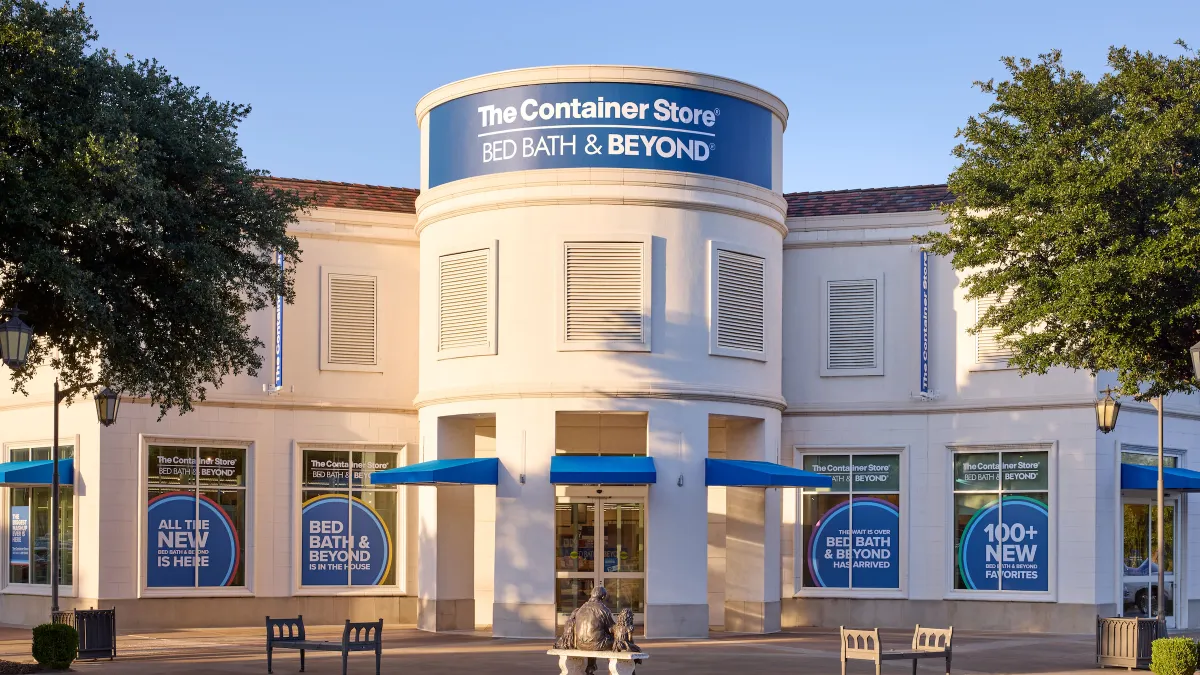
The company, formerly known as Bed Bath & Beyond, initiated a string of acquisitions that have included The Brand House Collective, The Container Store and more.
But more recently, weaknesses have emerged in Neighborhood Intelligence’s strategy. In September, the company called off its deal with F9 Brands, the owner of Cabinets To Go and Lumber Liquidators. And last month, it canceled its acquisition of real estate platform Fathom Holdings.
The turnaround strategy was an ambitious one, according to industry experts.
“It struck me as one that could only succeed if everything went right, and that doesn't tend to happen,” James Gellert, executive chair of financial analysis firm RapidRatings, said. “What we've seen here is, some of these component parts have not come together for a variety of reasons.”
Neighborhood Intelligence last month said it is now putting future acquisitions on hold as it focuses on organic growth at its core businesses.
“You can't execute a comprehensive and complex strategy when there are a lot of low common denominators that don't come together. The diversification that Neighborhood Intelligence was trying to achieve is not yet realized and may not be realized,” Gellert said. “You've got cash issues, you've got debt issues, you've got stock price issues — and that's on top of the business strategic concept and issues associated with those.”
This leaves questions surrounding Neighborhood Intelligence’s turnaround and its ambitions to position itself beyond a traditional retail company.
A strategy shift
The acquisitions of Fathom Holdings and F9 Brands were intended to help bolster Neighborhood Intelligence’s position within the home services and ownership pillars.
But those deals came as the company was in the middle of finalizing or integrating other acquisitions into its business — all during a particularly difficult period for home retailers.
“It is very difficult to integrate acquisitions particularly when several are planned at the same time, which adds a lot of complexity,” Cristina Fernández, managing director and senior research analyst at Telsey Advisory Group, said in an email.
The company in September called off its $150 million deal to acquire the Lumber Liquidators owner because “F9 was unable to satisfy all closing requirements within the contemplated timeframe.” And last month, Neighborhood Intelligence canceled its acquisition of Fathom because both companies determined the deal didn’t “appropriately reflect the fair value of either company for its shareholders.”
“We will continue to … walk away from things that don't make sense,” Lemonis said during a fireside chat with Wedbush in September. “We will continue to shed ourselves of people or locations that don't contribute. We will continue to run in a meritocracy model and the shareholders demand and expect results, and that's what we're here to deliver.”
Now, the company is focused on organic growth within its existing businesses, and Lemonis said “there will be no acquisitions of any materiality between now and the time we reach profitability.”
The executive said Neighborhood Intelligence’s retail business is $100 million short of being profitable. And in early October, Neighborhood Intelligence said it expects gross margin to be more than 30%, ahead of its earlier projections. It also said it has seen “encouraging revenue momentum” across its core business. The company reports third quarter earnings results on Thursday.
But weaknesses across the company remain.
What’s needed?
With two deals canceled and further acquisitions off the table in the near term, “the broader strategy now needs a different path to execution,” Jonathan Matuszewski, Jefferies equity analyst, said in an Oct. 5 research note.
On top of an uncertain strategy, Neighborhood Intelligence is also attempting to execute a turnaround amid leadership changes. Around the time the Fathom deal was called off, it was announced Brian LaRose was resigning as CFO.
LaRose was chief financial officer of The Container Store and was named CFO of the broader organization in April.
“Our focus is to simplify the business, flatten the organization and remove unnecessary costs while continuing to grow revenue and expand margin,” Lemonis said at the time. “We have made meaningful progress, and we are assembling the right team and expertise to continue that work.”
Neighborhood Intelligence appointed Paul Kosturos, managing director at Alvarez & Marsal, to serve as CFO on an interim basis. The company also expanded its partnership with Alvarez & Marsal to advise on organization structure, finance and accounting, and tech consolidation.
The move was part of a broader restructuring of its financial leadership team, which also included the appointments of Jill Windrum as chief accounting officer and deputy CFO and Emma Haugh as Retail CFO.
“A CFO leaving with a short time frame is usually not a good sign,” Fernández said. The interim hire from Alvarez & Marsal, a firm known for its turnaround and restructuring expertise, “signals that the businesses are challenged and the company needs to significantly cut costs and improve the operating model,” she added.
Neighborhood Intelligence’s financial risk is also elevated, even as the broader retail industry is improving. The industry in general is doing better than it was in that there are more low- and medium-risk companies and fewer high-risk companies, according to Gellert. But that has also created a greater bifurcation between low- and high-risk companies.
“The companies that are doing well are doing pretty well. The companies that are not doing well are doing worse,” Gellert said. “Companies that are struggling are struggling more than they were before, which suggests to me that we will continue to see more restructurings and more bankruptcies as we go forward. It will make these combinations — like Neighborhood Intelligence has been striving for — it'll just make them harder to execute.”
RapidRatings assesses a company’s near-and medium-term financial health through its Financial Health Ratings and Core Health Scores. FHR and CHS ratings under 40 are considered at least “high risk” and in “poor health,” respectively.
Neighborhood Intelligence’s current FHR is 34, while its CHS is 25.
“What you tend to see in companies that are improving is possibly a consistent Financial Health Rating for a number of years, but where Core Health Score is ticking up as the underlying improvements in profitability and cost structure efficiency and working capital efficiency and so forth take hold,” Gellert said. “We don't see that yet in this story.”
The stronger companies have been able to raise capital, allowing them to move out of higher-risk areas, he said. Meanwhile, weaker companies have fewer sources of capital and less options, “and when they have them, they're more expensive.”
For companies that have borrowed on a floating rate basis, the cost of capital has gone up as interest rates have risen. “A lot of these companies that borrowed three years ago and four years ago were anticipating a lower interest rate environment, not a higher one,” Gellert said. “The bet has moved against them.”
Neighborhood Intelligence last month announced a $45.5 million registered direct offering, which was led by certain funds managed by Highbridge Capital Management. The company at the time said it would use the proceeds to build out its inventory and support its recent acquisitions.
While the move isn’t necessarily unusual, according to Gellert, it’s also not an everyday occurrence.
“You typically see this in companies that have to get creative around raising capital, as opposed to larger, much stronger businesses that have a steady influx of capital and sources of capital,” he said. “So, if Neighborhood was doing incredibly well, you wouldn't necessarily see this. However, it's not a pre-packaged bankruptcy or a distressed deal per se.”
Looking ahead, Neighborhood Intelligence will need to focus on proving their core business of retail is viable, Gellert said.
“They certainly have to evaluate the strategy,” he said. “If the strategy was to diversify across these new pillars in 2026, that's not working — and it won't work.”